.png)
Why Measuring Emotions Matters

Updated: Aug 28, 2025
Breaking Down 96 Discrete Emotional Dispositions
Behind every success or struggle is a pattern of emotions. These patterns aren’t random—they can be measured, analyzed, and used to unlock personal and organizational growth. Measuring emotions isn’t just a research exercise; it’s a way to understand how feelings translate into actions, and how those actions lead to results.
The Framework: 96 Emotional Dispositions
Our approach is grounded in a research-backed framework built from three layers:
4 Neurological Domains (Cognitive, Affective, Motivational, Physiological)
3 Achievement Timeframes (Before, During, and After an Event)
8 Core Achievement Emotions (Joy, Hope, Pride, Anger, Anxiety, Shame, Hopelessness, Boredom)
These layers combine into 96 discrete emotional dispositions, giving a detailed map of how emotions drive behavior across different contexts and timeframes. This helps individuals and organizations see beyond vague feelings, capturing precise patterns that can enhance performance, well-being, and resilience.
Visual Insight: Gender and Achievement Emotions

This graph shows how the eight core achievement emotions—Joy, Hope, Pride, Anger, Anxiety, Shame, Hopelessness, and Boredom—appeared in a sample dataset comparing male and female participants.
A few patterns stand out:
Females in this sample set scored slightly higher on Joy, Hope, and Pride, emotions that tend to enhance engagement and motivation when paired together.
Males in this sample set scored slightly higher on Anger and Boredom, emotions that can be adaptive in small doses but, if left unregulated, often cluster with Hopelessness and Shame, creating potential barriers to sustained achievement.
Emotions don’t act in isolation. Correlation patterns show that certain emotions enhance each other (like Joy, Hope, and Pride), while others inhibit those positives (like Anger, Shame, and Hopelessness). Understanding these interactions is critical to seeing the why behind the numbers.
It's important to note that this is a sample dataset—patterns can vary widely by group, industry, or individual. For example, in the workplace where this data was collected, open discussion revealed that male participants often felt overwhelmed by the higher-energy dynamics of the female group, which likely contributed to their elevated negative emotion scores.
This doesn’t mean “cause and effect” in a strict sense—it shows that emotions are interconnected and can shift based on context and group dynamics. That’s why measuring emotions matters: general trends spark curiosity, but personalized data drives real insight and action.
Why Personalized Measurement Matters
When individuals or organizations measure their own 96 discrete emotional dispositions, they gain insight into:
Which emotions consistently enhance their momentum.
Which emotions inhibit progress and cluster together.
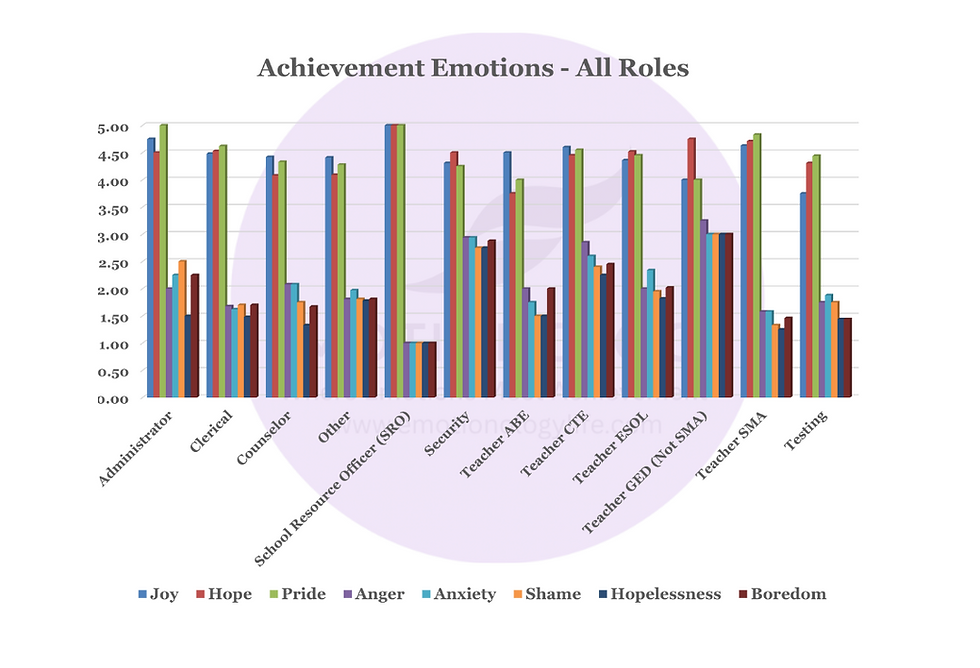
How these patterns differ by role, context, or individual traits.
This level of understanding empowers teams and individuals to move beyond assumptions and use emotion science as a strategic tool.
Ready to See What Your Emotions Reveal?
Don’t settle for averages or assumptions. Discover your own emotional map.
Ready to harness your achievement emotions? 💜📊The data is clear — knowing your emotional patterns can help you design strategies that work with your strengths, not against them.
📩 Join the Emotionology Life community to get more research-based insights, practical tools, and strategies delivered straight to your inbox. You’ll also be the first to know when new articles, workshops, and resources go live.


Comments