.png)
Are Our Emotions Age-Dependent?

Updated: Aug 28, 2025
What the Data Says About Millennials, Gen Z, and Beyond
Conversations about generations often come with sweeping statements: “Gen Z is the most anxious generation,” “Millennials are disengaged,” or “Older generations are more resilient.” But these claims rarely look at what the data actually shows about how emotions shape achievement across different age groups. When we measure emotions, we find a more nuanced—and far more useful—story.
Why Age Matters in Understanding Emotions
Age isn’t just a number when it comes to achievement emotions. Life stage, career phase, and personal experience can all influence how we experience positive emotions like Joy, Hope, and Pride—or negative emotions like Anger, Anxiety, and Hopelessness. By looking at actual data, we can move beyond stereotypes and better understand how emotions cluster across different groups.
Visual Insight: Are Our Emotions Age-Dependent?

The conversation about generational differences—Millennials vs. Gen Z vs. Boomers—often focuses on stereotypes: “Gen Z is more anxious,” “Millennials are disengaged,” or “Older generations are more resilient.” But what does the data actually show?
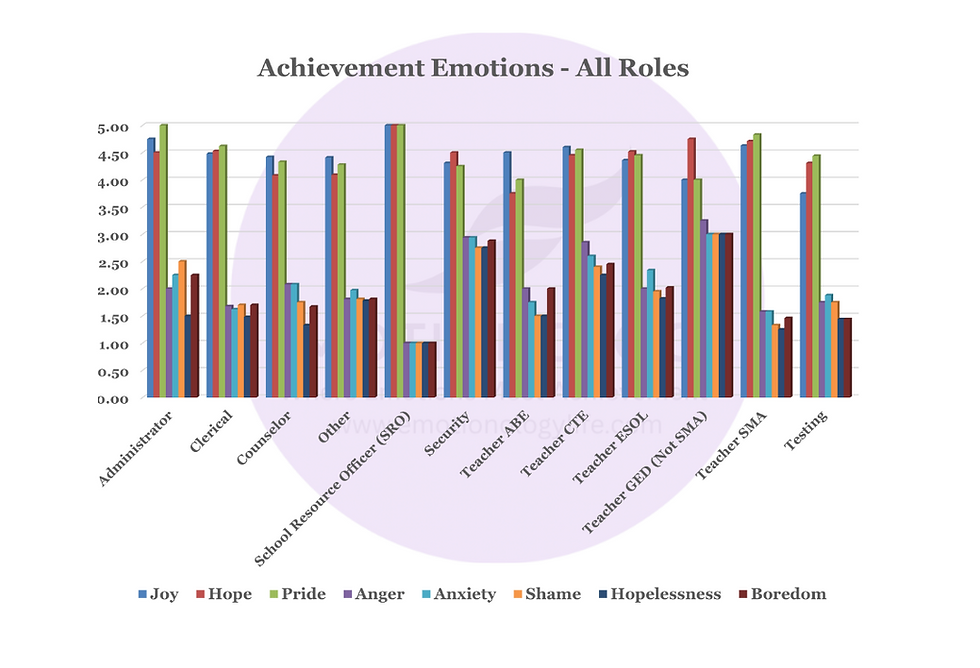
This graph highlights how the eight core achievement emotions—Joy, Hope, Pride, Anger, Anxiety, Shame, Hopelessness, and Boredom—appear across multiple age groups. While every dataset will vary, this sample set gives us a few intriguing insights:
Younger adults (18–20 and 21–29) report high levels of Joy, Hope, and Pride, but also show elevated Anger and Boredom, suggesting strong energy and engagement paired with volatility that can cluster with Anxiety or Shame.
Mid-career adults (30–49) show more balanced emotional profiles, with solid scores in Joy, Hope, and Pride, and lower—but still notable—negative clusters like Anxiety and Hopelessness.
Older groups (50+ and 60+) tend to report steadier emotional ranges, with fewer peaks in negative emotions and consistent levels of Joy, Hope, and Pride, suggesting stability but potentially less emotional intensity overall.
It’s important to note that this is a specific dataset—patterns can and will vary across different populations. These trends don’t define a generation; they simply show how emotions can shift by age in this group, giving us a glimpse of how life stage and experience might influence achievement-related feelings.
Most importantly, emotions don’t act alone. Correlation patterns show that positive emotions (Joy, Hope, Pride) tend to enhance each other, while negative emotions (Anger, Anxiety, Shame, Hopelessness, Boredom) often cluster, influencing how each age group experiences motivation, resilience, or burnout.
Which age group feels most like you, emotionally? Are your patterns closer to the high-energy, high-volatility younger groups—or the steadier but less intense older profiles? How might your emotions cluster differently if we measured your personal data?
Moving Beyond Stereotypes with Real Data
Charts like this show trends, but they don’t tell your whole story. Two people the same age can have entirely different emotional profiles, and two teams made up of the same age range can still function very differently. That’s because emotions cluster uniquely for every individual and group.
Understanding your own emotional map means you can:
Identify which emotions help you stay motivated and resilient.
Recognize which clusters of emotions (like Anxiety and Shame) may need attention.
Learn how your age, role, and context shape your emotional experience—and use that insight to improve your results.
Ready to See How Your Emotions Measure Up?
Move past stereotypes and discover what your emotions actually reveal. Order your Emotional Profile Assessment today to see how your emotions enhance and inhibit each other—and get strategies tailored to your personal and professional goals.


Comments